
MailerLite vs ActiveCampaign (plus mailfloss): Which Email Marketing Platform Should You Choose in 2026?
Compare MailerLite's simplicity and free plan vs ActiveCampaign's automation power—plus why mailfloss keeps both platforms delivering.

MailerLite vs ActiveCampaign — which is right for you?
Choose MailerLite for clean, affordable email marketing with a gentle learning curve; choose ActiveCampaign when you need advanced automation and CRM-style workflows. Both charge by subscriber, so a bloated or invalid list inflates cost and hurts deliverability — mailfloss connects to each to verify addresses, fix typos, and remove inactive contacts automatically.
- MailerLite: simple, affordable, great for creators and small businesses.
- ActiveCampaign: powerful automation and CRM features for complex journeys.
- Subscriber-based pricing means invalid contacts waste budget and reputation.
- mailfloss keeps both lists clean and verified, with no-dev setup.
MailerLite vs ActiveCampaign (vs mailfloss): Which Email Marketing Platform Should You Choose in 2026?
Choosing between MailerLite and ActiveCampaign for your email marketing often comes down to five questions:
- Do you need simple, affordable email tools, or automation that can run complex multi-step campaigns?
- Is ease of use more important than depth of features?
- Do you want a built-in CRM alongside your email marketing, or is email your primary focus?
- Are you a solo creator or small team, or a growing business with segmentation needs?
- Do you understand that the quality of your email list determines how well either platform performs?
In short, here's what we recommend:
MailerLite is the choice for creators, solopreneurs, and small businesses who want professional email marketing without the complexity. Its drag-and-drop editor, free plan (up to 500 subscribers with 12,000 emails per month), and all-in-one toolkit covering websites, landing pages, digital product sales, and paid newsletter subscriptions make it easy to launch and grow. MailerLite earns consistent recognition for ease of use (G2 Easiest to Use 2025) and deliverability (EmailToolTester Best of 5 Deliverability 2024).
The trade-off: its automation builder lacks the branching logic and CRM integration that growing businesses eventually need.
ActiveCampaign is built for businesses that have outgrown basic email tools and need automation that handles complex customer journeys. Its visual automation builder supports behavioral triggers, conditional branching, and cross-channel coordination across email, SMS, and WhatsApp. The built-in CRM, Active Intelligence AI system, and 1,000+ integrations give marketing teams real capability.
But that capability comes with a steeper learning curve, higher pricing that escalates as your contact list grows, and a volume of features that can overwhelm smaller teams.
Both platforms send emails well. But here's the problem neither one solves: your email list is decaying right now. Industry data shows roughly 2.1% of email addresses go bad every month. Invalid addresses pile up silently, driving bounces higher, dragging sender reputation down, and pushing your campaigns into spam folders, even for subscribers who want to hear from you. That's where mailfloss comes in.
mailfloss is the automated email list cleaning service that connects directly to both MailerLite and ActiveCampaign (two of the 40 ESP platforms it integrates with natively) and cleans your list every day without manual effort. It identifies invalid, fake, and risky email addresses and removes them automatically, while its Auto Typo Fixer recovers real subscribers by correcting misspelled domains like "gmial.com" or "yahooo.com," recovering 80-90% of misspelled addresses and syncing the fix back to your ESP. mailfloss isn't an alternative to MailerLite or ActiveCampaign. It's the foundation that makes whichever platform you choose actually deliver.
If a clean email list sounds like the missing piece of your email marketing, see how mailfloss works with your platform.
MailerLite vs ActiveCampaign at a glance
MailerLite | ActiveCampaign | mailfloss | |
|---|---|---|---|
Primary focus | Email marketing & creator tools | Marketing automation & CRM | Automated email list verification |
Ease of use | Intuitive, minimal learning curve | Capable but steeper learning curve | Set-and-forget after 60-second setup |
Free plan | Up to 500 subscribers, 12,000 emails/month | 14-day trial only (no free plan) | 7-day free trial (full platform access), then paid plans |
Automation depth | Visual builder, good for standard workflows | Advanced branching, behavioral triggers, AI-powered | Fully automated daily cleaning + real-time verification |
CRM | Not included | Built-in with deal pipelines and lead scoring | N/A |
AI capabilities | AI writing assistant, AI subject lines | Active Intelligence with 12+ AI agents | Deep Clean Engine for hard-to-verify domains |
Integrations | 150+ native integrations | 1,000+ integrations | 40 native ESP integrations including both |
Deliverability tools | Built-in email verifier (MailerCheck) | Dedicated IP, DKIM/DMARC, private network routing | Daily automated list cleaning, typo correction, real-time verification |
Starting price | $10/month (500 subscribers) | $15/month (Starter, 1,000 contacts) | $29/month (10,000 credits) |
MailerLite wins on simplicity and value
MailerLite was built around what the company calls its "Lite philosophy": making the complex simple. In practice, this means a clean interface where non-technical users can create campaigns, build automations, and design landing pages within minutes of signing up.
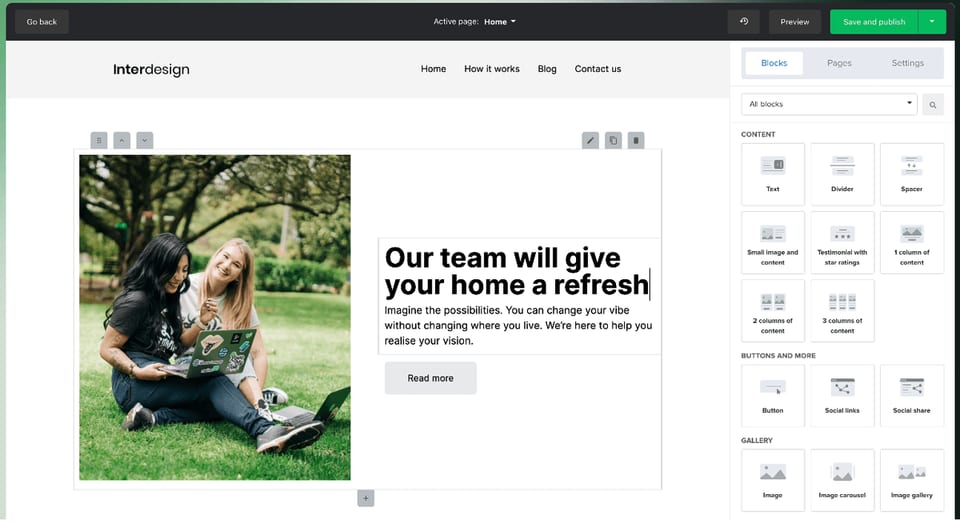
The drag-and-drop email editor is a pleasure to use. Content blocks for countdown timers, embedded surveys, product listings, and auto-generated YouTube thumbnails work without add-ons or workarounds. Three editor modes (drag-and-drop, rich-text, and custom HTML) let beginners and developers work in the same account at whatever depth they prefer. An AI writing assistant is built into the editor for generating copy without leaving the workflow.

Source: MailerLite
The value goes beyond email. MailerLite bundles a website builder, blog, landing pages (10 free on the Free plan), signup forms, paid newsletter subscriptions, digital product sales, and appointment booking under one subscription. MailerLite charges 0% commission on digital product sales, paid subscriptions, and paid booking sessions, with only Stripe's standard processing fee applied. For a solo creator paying $10/month, that's a stack of tools that would otherwise cost several separate subscriptions.
Source: MailerLite
The free plan is one of the most generous in the category. Up to 500 subscribers, 12,000 emails per month, automation workflows with up to 100 steps, one website, 10 landing pages, and unlimited embedded forms and pop-ups, all at no cost.
Where MailerLite falls short is depth. Users who need complex multi-branch automation logic, CRM-connected workflows, or enterprise-level segmentation regularly cite this as the ceiling they hit. There is no built-in CRM with deal pipelines or lead scoring. Native integrations number around 150, far fewer than ActiveCampaign's ecosystem.
ActiveCampaign wins on automation power and CRM
ActiveCampaign is where email marketing becomes marketing automation. The platform's visual automation builder is its defining feature: users create multi-step workflows with conditional branches, behavioral triggers, wait periods, and split tests that route each contact through a personalized journey based on their actions.
The trigger options run deep. Automations can fire based on email opens, link clicks, tag additions, form submissions, purchase events, custom field changes, web page visits, or deal stage movements. A welcome email sequence that sends different content depending on whether the subscriber clicked your pricing page, downloaded a resource, or just browsed is straightforward to set up.
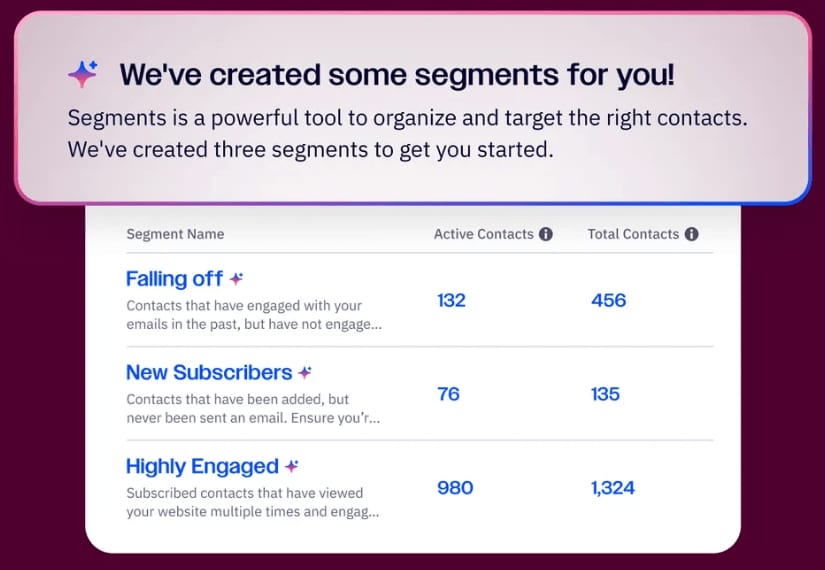
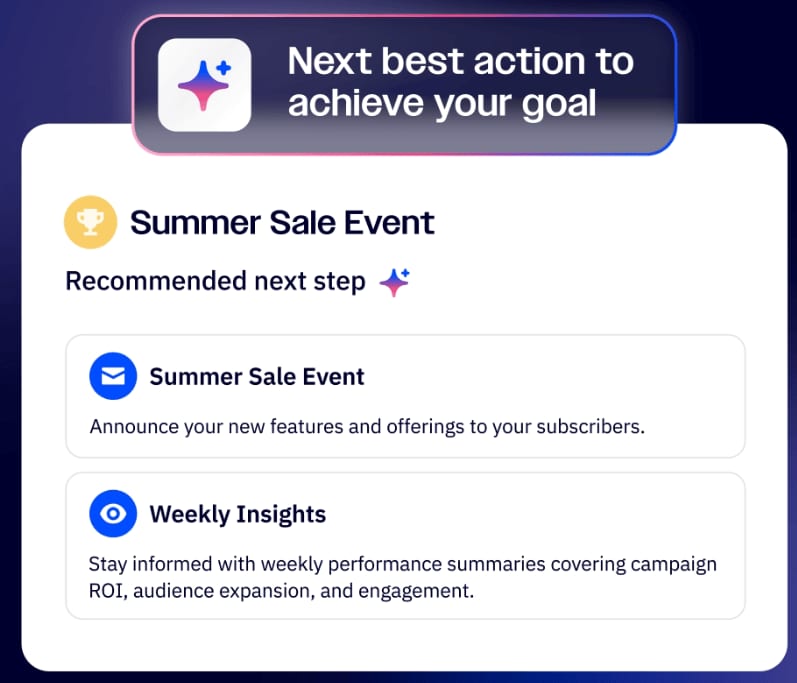
Active Intelligence, launched in May 2025, is ActiveCampaign's AI layer. Rather than offering isolated AI features, it works as a system across the platform. The AI Campaign Builder generates complete campaigns from plain-language prompts. Predictive Sending analyzes each subscriber's engagement history to determine the optimal send time for that person, not just the list. AI-Suggested Segments analyze audience data and surface high-value groups automatically.
Source: ActiveCampaign
The built-in CRM is a genuine differentiator over MailerLite. It includes visual deal pipelines, lead and deal scoring (two separate scoring systems), automated sales routing, 1:1 email tracking from deal records, and win probability analysis. Because the CRM lives inside the same platform that handles email, SMS, and web tracking, deal records are automatically enriched with the contact's full behavioral history. No integration required.
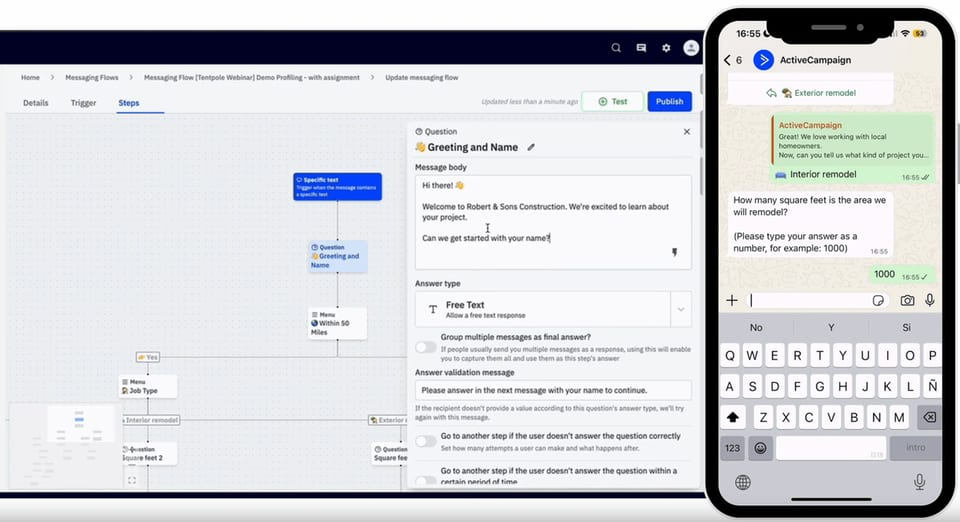
ActiveCampaign also goes beyond email. SMS marketing, WhatsApp messaging (added via the 2025 Hilos acquisition), and transactional email via Postmark are all coordinated from one automation builder.
Source: ActiveCampaign
The trade-off is complexity. Capterra reviewers note that mastering conditional logic, tagging systems, and custom reports takes significant ramp-up time. The feature set is broad enough that new users can feel overwhelmed before they build their first automation. And pricing climbs as contact lists grow, with G2 reviewers reporting that costs have increased substantially over the past three years.
The pricing gap widens as you grow
The cost difference between MailerLite and ActiveCampaign is modest at small list sizes but diverges sharply as subscriber counts increase.
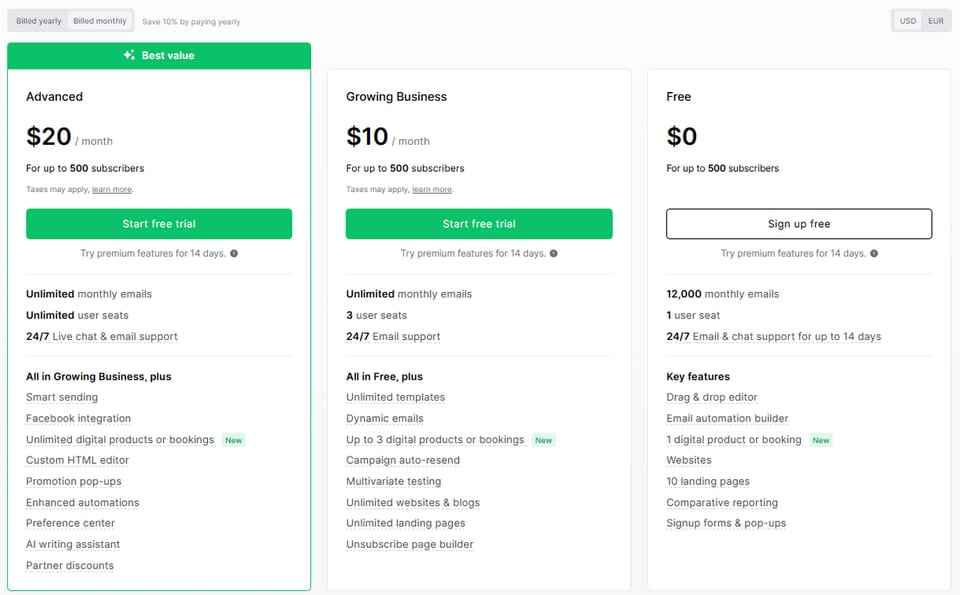
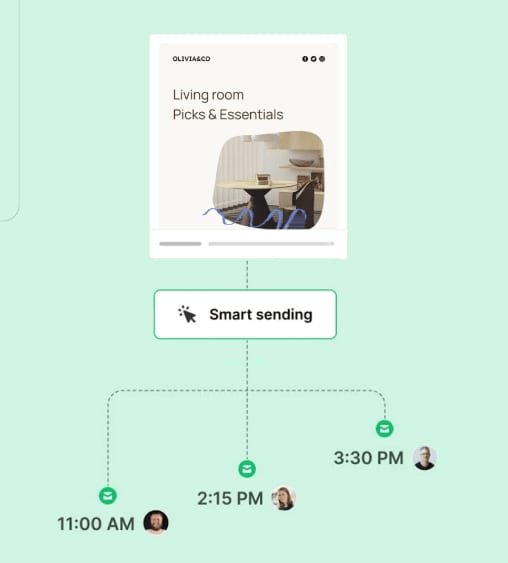
MailerLite starts at $10/month for the Growing Business plan (500 subscribers, unlimited emails). At 50,000 subscribers, the same plan costs $289/month. The Advanced plan starts at $20/month and adds smart sending, multi-trigger automations, and the custom HTML editor. All paid plans include unlimited email sends, and subscribers are counted once regardless of how many groups they belong to.
Source: MailerLite
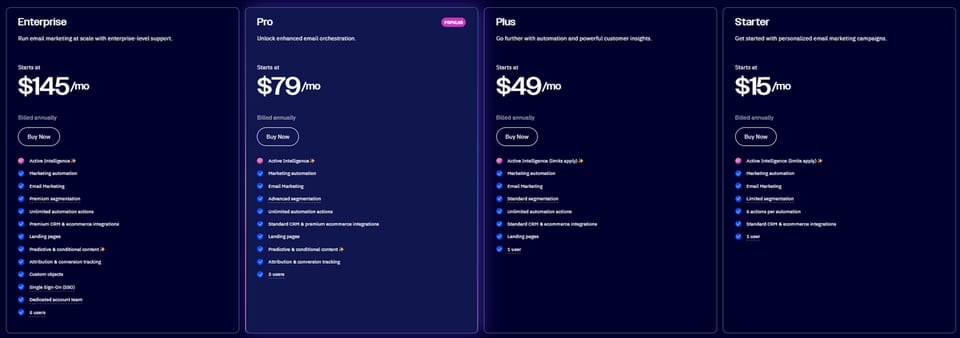
ActiveCampaign starts at $15/month for the Starter plan (limited to 1,000 contacts and 5 automation actions). The Plus plan removes the automation cap and adds landing pages, AI content generation, and multichannel automation. The Professional plan (starting with 3 user seats) unlocks advanced segmentation, predictive sending, conditional content, and revenue attribution. Enterprise pricing is custom. At 10,000 contacts, the Starter plan costs $149/month. ActiveCampaign charges once per unique contact regardless of tags or segments, but email send limits are capped at 10x-15x the contact limit per month depending on the plan, with $0.005 per email charged on overages.
Source: ActiveCampaign
MailerLite's compare page claims customers switching from ActiveCampaign save 47% on average. The math checks out at most list sizes. For a 10,000-subscriber account, MailerLite's Growing Business plan with unlimited sends costs a fraction of what ActiveCampaign charges at the same tier for comparable email marketing features.
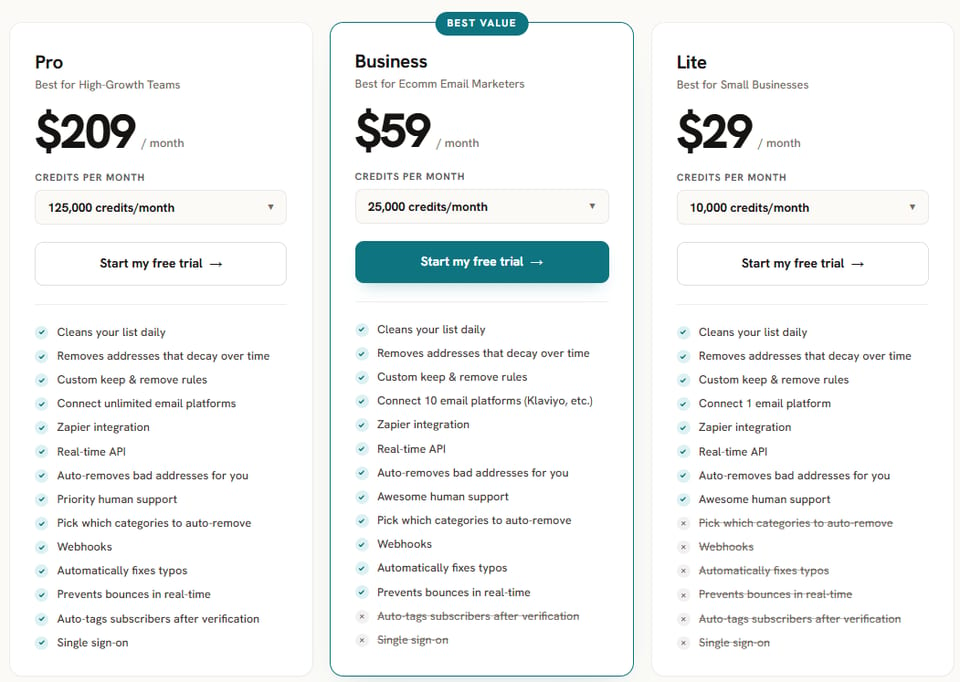
mailfloss operates on a credit-based model separate from either platform. The Lite plan ($29/month) covers 10,000 verifications per month with 1 ESP integration. Business ($59/month) adds 25,000 credits, up to 10 ESP integrations, the Auto Typo Fixer, and real-time verification. Pro ($209/month) includes 125,000 credits and unlimited ESP integrations. The platform is self-serve with no sales calls required. The investment pays for itself by ensuring you're not paying MailerLite or ActiveCampaign for contacts that don't exist, while the Auto Typo Fixer recovers real subscribers worth an estimated $8 each in lifetime value (revenue that would otherwise be permanently lost).
Neither platform fully solves the deliverability problem
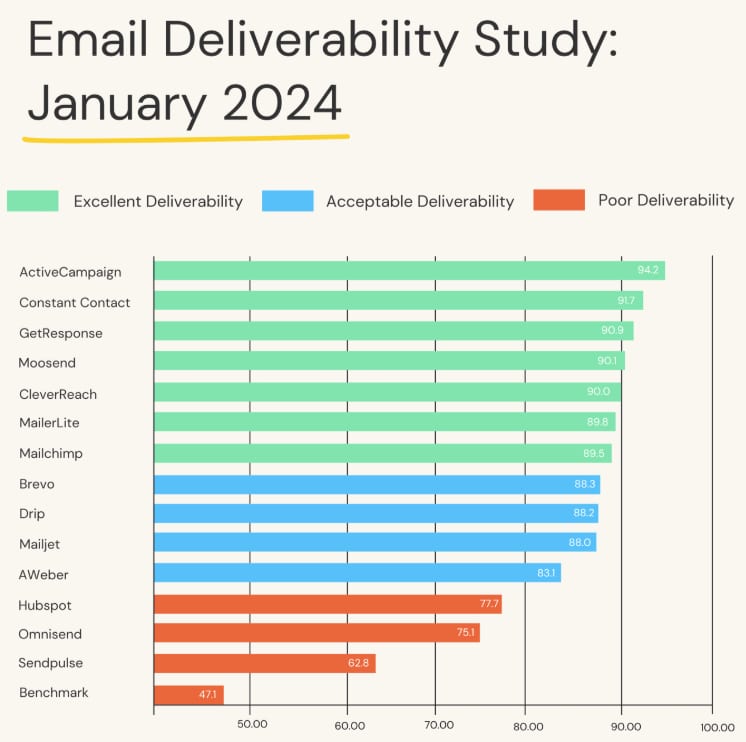
Both MailerLite and ActiveCampaign invest in deliverability infrastructure. MailerLite earned EmailToolTester's Best of 5 Deliverability award in 2024 and holds G2's Email Deliverability Leader badge. ActiveCampaign reports 99.88% email deliverability with infrastructure including dedicated IPs, DKIM/DMARC authentication, and private network routing. 93% of their surveyed customers report deliverability better than competitors.
These are strong foundations. But deliverability infrastructure protects the pipeline. It doesn't clean the list that flows through it.
Source: EmailToolTester
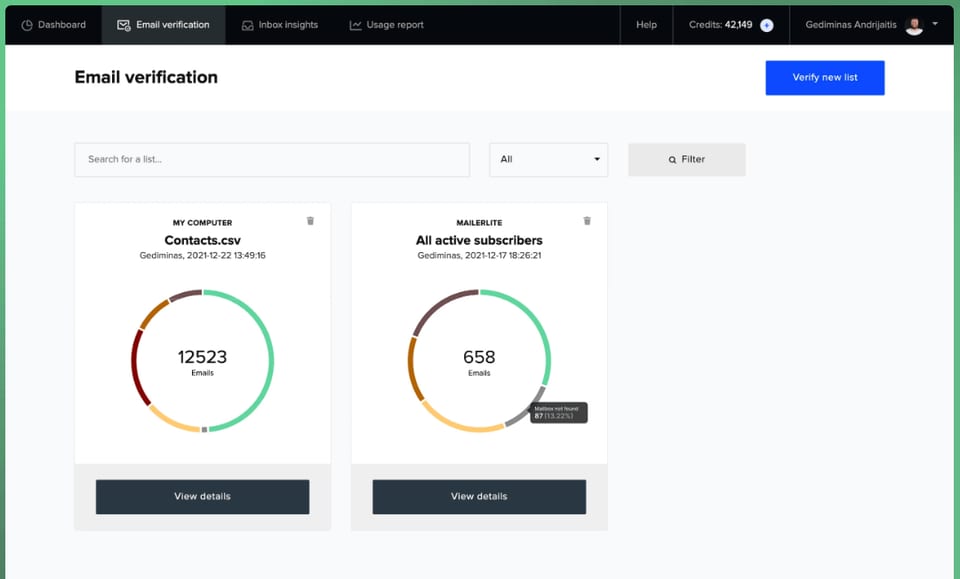
Email lists decay at roughly 2.1% per month. People change jobs, abandon addresses, and create temporary accounts. Over a year, that compounds to more than 20% of your list becoming dead weight. MailerLite includes MailerCheck, its built-in email verifier, which can check addresses via bulk upload, single lookup, or real-time API. ActiveCampaign handles bounce processing and offers domain authentication tools. But both approaches are reactive. By the time an address hard bounces, the damage to your sender reputation is already done.
Source: MailerLite
mailfloss takes a different approach: automated, daily, proactive cleaning. Once connected to your MailerLite or ActiveCampaign account, mailfloss scans every new address added since the previous day. Invalid, disposable, role-based, and spam-associated addresses are flagged and acted on automatically, whether that means deletion, unsubscription, or tagging for review. Users can adjust how aggressive the verification is, balancing thoroughness with subscriber retention based on their business needs. The process runs in the background every day without manual effort.
mailfloss's Deep Clean technology goes beyond the syntax validation and server pinging that all verification services perform, running proprietary tests that catch invalid addresses standard methods miss, particularly on "accept-all" domains where even fake addresses pass basic checks.
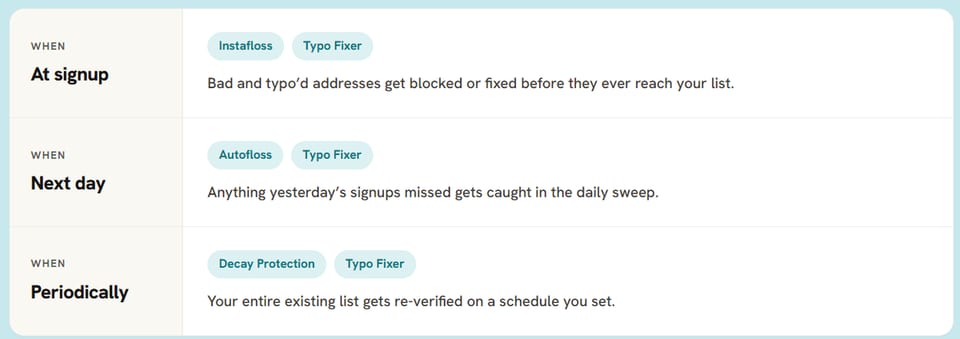
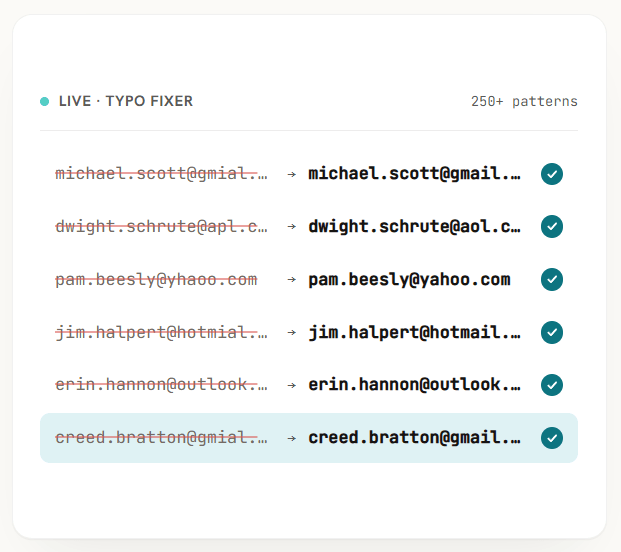
The Auto Typo Fixer adds a recovery layer that neither platform offers natively. When someone signs up with "gmal.com" or "yaho.com," most verification tools flag it as invalid. mailfloss corrects the misspelling and syncs the fixed address back to the ESP, recovering 80-90% of misspelled addresses that would otherwise be lost. For businesses running paid ads, mailfloss's Instafloss feature validates emails in real time at the point of signup, catching typos and invalid addresses before they enter your list (preventing wasted ad spend when users sign up with errors and never receive their coupons or content).
Jen Perdew, CMO of NAMS, achieved a 99% Sender Score after mailfloss cleared 647 spam traps from their list. She describes it as "the only piece of software that I use every single month that I don't even have to think about." (NAMS Case Study)
Automation comparison: simple workflows vs complex journeys
Automation is where the gap between MailerLite and ActiveCampaign is widest.
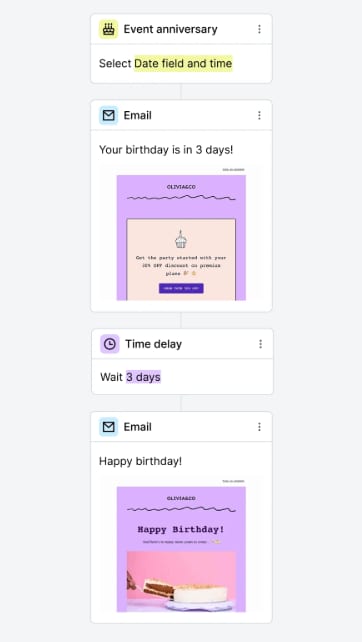
MailerLite's automation builder covers the workflows most small businesses need: welcome sequences, abandoned cart recovery, post-purchase follow-ups, birthday emails, and re-engagement campaigns. Triggers include group joins, link clicks, form completions, product purchases, custom field updates, and date-based events. Condition nodes let you branch based on campaign activity, segment membership, or custom field values. Pre-built automation templates get common sequences running quickly.
Source: MailerLite
The free plan includes automations with up to 100 steps, which is generous. But the branching logic stays simple. Users who need multi-condition workflows, extensive A/B testing within automations, or CRM-triggered sequences will find the ceiling.
ActiveCampaign's automation builder is built for complexity. Workflows can include unlimited actions (on Plus plans and above), conditional splits responding to any combination of behavioral signals, and cross-channel steps that coordinate email, SMS, and WhatsApp in a single flow. The AI-powered builder converts plain-language prompts into configured automations, including wait periods, branching paths, and action steps. AI-Suggested Actions draw on billions of anonymized data points from similar businesses to recommend complete marketing sequences.
Source: ActiveCampaign
ActiveCampaign also connects automations directly to its CRM. A form submission can create a deal, assign it to a sales rep based on lead score, trigger a personalized email from that rep's address, and update the deal stage when the contact responds, all in one automation. This kind of sales-marketing integration is not possible in MailerLite, which has no CRM.
For MailerLite users, the automation covers the essentials well. For ActiveCampaign users, it can handle virtually anything a marketing team can design.
Content creation and design tools
Both platforms provide strong email design tools, but with different philosophies.
MailerLite offers three newsletter editors: a drag-and-drop builder with blocks for countdown timers, embedded surveys, product listings, and social sharing; a rich-text editor for clean, personal-feeling emails; and a custom HTML editor (Advanced plan) with automatic CSS inlining. Dynamic content blocks show or hide sections based on subscriber segments from a single email.
Source: MailerLite
Beyond email, MailerLite's content toolkit extends to a website builder with free hosting and SSL, a blog with built-in RSS-to-email campaigns, and a landing page builder with up to 5-variant A/B testing and click heatmaps. The AI landing page generator (Advanced plan) creates complete page layouts from a single prompt.
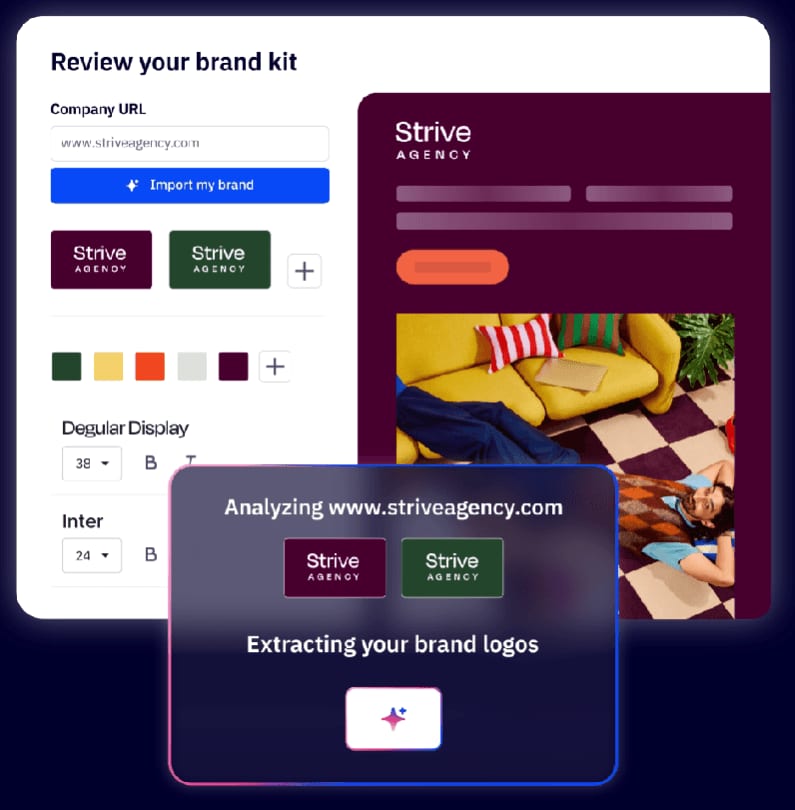
ActiveCampaign centers its content creation on the Email Designer, a drag-and-drop builder with 250+ templates. The AI Brand Kit imports brand assets (logos, fonts, colors) from a website URL, eliminating manual brand setup. An AI Content Generator produces email copy, subject lines, and SMS campaigns, while an AI Image Generator creates custom visuals. Predictive content uses NLP to select the best content variant for each contact automatically.
Source: ActiveCampaign
ActiveCampaign includes a landing page builder on Plus plans and above, though it's more limited in customization than MailerLite's. Capterra reviewers consistently flag limited landing page and form customization as a weak point.
For creators who need websites, blogs, and landing pages alongside their email, MailerLite's all-in-one toolkit is hard to beat at its price point. For marketers who need AI-powered personalization across email content, ActiveCampaign's predictive content and brand tools go further.
Integration ecosystems reflect different scales
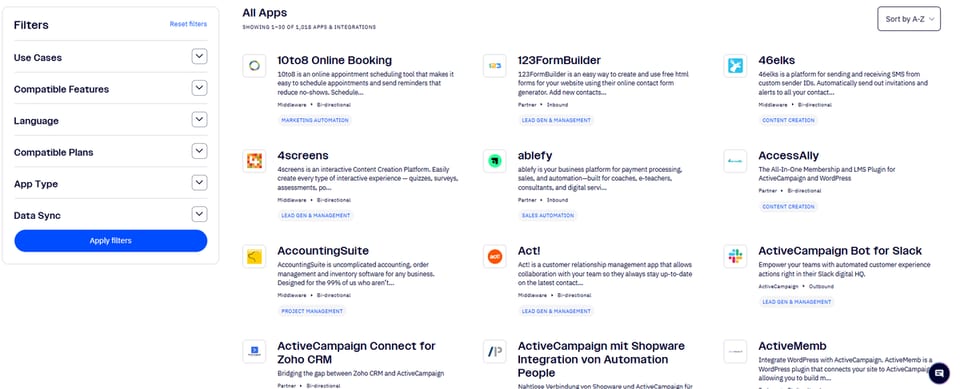
ActiveCampaign connects to over 1,000 apps, including Salesforce, Shopify, WooCommerce, WordPress, Google Ads, Facebook, Zapier, Make, Clay, Calendly, Stripe, and Slack. The REST API covers contacts, campaigns, automations, deals, custom objects, webhooks, and more. The platform was also the first marketing platform in Claude's official connector directory via MCP, enabling AI tools to query campaign data and trigger automations through natural language.
Source: ActiveCampaign
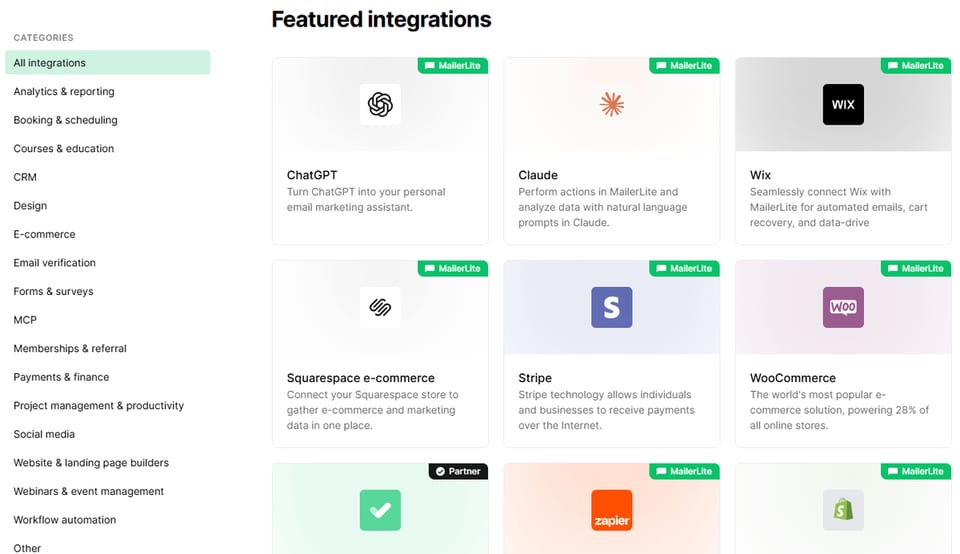
MailerLite offers around 150+ native integrations spanning e-commerce (Shopify, WooCommerce, BigCommerce), payments (Stripe), CMS platforms (WordPress, Squarespace, Wix), design tools (Canva, Figma), CRMs (HubSpot, Pipedrive, Salesforce via third-party), and AI tools (ChatGPT, Claude via MCP). The REST API is well-documented with SDKs for PHP, Go, Node.js, Python, and Ruby. Zapier connects MailerLite to 5,000+ additional apps.
Source: MailerLite
mailfloss takes a different approach. Rather than competing on breadth, it focuses on depth with 40 native ESP integrations that connect directly to the platforms where your contacts live. Both MailerLite and ActiveCampaign are supported. For developers, a REST API handles real-time single-email verification and batch processing, plus a JavaScript Widget for front-end form validation. Webhooks (Business and Pro plans) enable downstream workflow triggers on verification events.
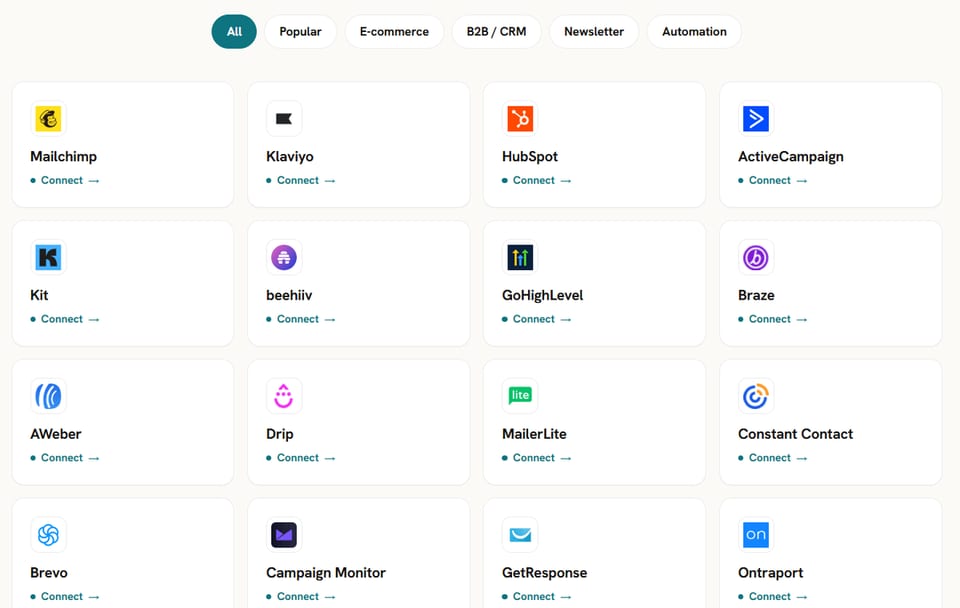
The practical difference: ActiveCampaign users rarely need to leave the platform for marketing functionality. MailerLite users may lean on Zapier or Make for connections the platform doesn't support natively. mailfloss users connect once and never think about it again.
Support models match each platform's audience
MailerLite provides 24/7 live chat and email support with a published 97% satisfaction rate and 5-minute average live chat response time. Free plan users get support for the first 14 days; all paying users get full 24/7 access. Self-service resources include the MailerLite Academy (free courses with certification), video tutorials, live webinars, and a structured knowledge base. A Hire an Expert marketplace connects users with approved consultants for implementation help.

Source: MailerLite
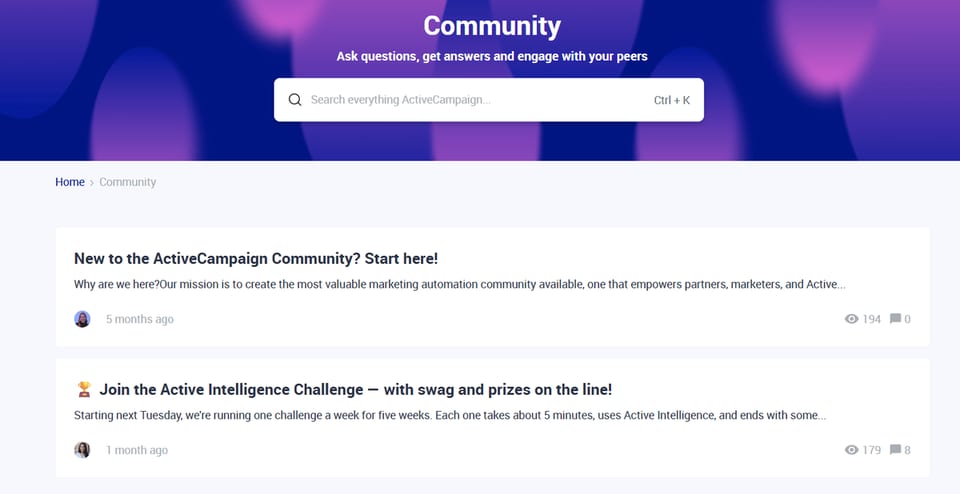
ActiveCampaign includes chat and ticket support on all paid plans. Professional plans add priority email and chat support. Enterprise customers receive a dedicated account team. The ActiveCampaign Community has 180,000+ members, and a Certified Consultants directory offers third-party expert help. Paid specialist sessions starting at $79 cover implementation, deliverability consulting, and complex migration support. Free migration of contacts, templates, segments, and campaigns is included for all paid plans.
Source: ActiveCampaign
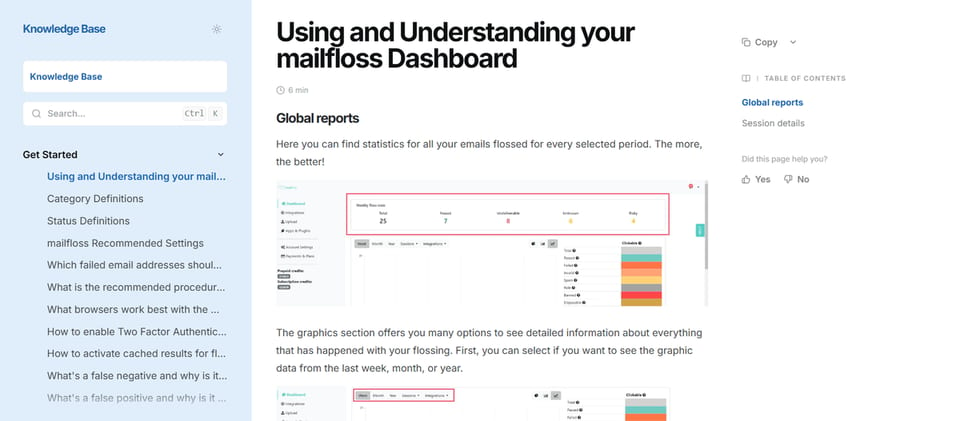
mailfloss offers email support across all tiers, with priority support on the Pro plan. A free onboarding call is available. As a smaller, founder-led company, mailfloss provides more personalized, hands-on customer support (a real advantage for businesses that need direct help getting set up). The knowledge base includes step-by-step guides for each of its 40 ESP integrations.
Who each platform is built for
The ideal customer for each platform is distinct.
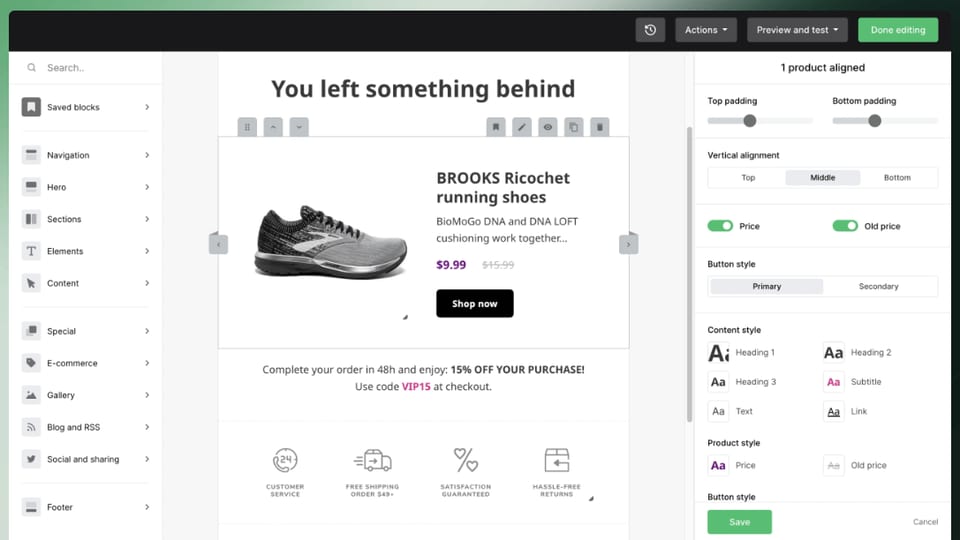
MailerLite is built for solopreneurs, content creators, authors, and small businesses who want a professional email marketing toolkit without enterprise complexity. The platform makes particular sense for newsletter operators who want to monetize through paid subscriptions (at 0% commission, compared to Substack's 10% cut), creators selling digital products, and small e-commerce stores that need email automation connected to Shopify or WooCommerce without paying for Klaviyo. Over 1 million creators and businesses use MailerLite, with 41,651 e-commerce stores among them.
Source: MailerLite
ActiveCampaign targets growth-stage SMBs and mid-market companies (roughly 10-500 employees) that need marketing automation, CRM, and cross-channel coordination under one roof. The platform's stated mission is "to help small teams power big business." It's strongest for SaaS companies running trial conversion and onboarding sequences, e-commerce brands building complex post-purchase flows, franchise and multi-location businesses needing centralized-yet-localized marketing, and any business where marketing and sales teams need shared visibility into the customer journey. 180,000+ businesses across 170+ countries use ActiveCampaign.

Source: ActiveCampaign
mailfloss is built for e-commerce and direct-to-consumer brands where email is a direct revenue driver and list quality has real financial consequences. The ideal customers are B2C operations collecting emails from consumers through content upgrades, newsletters, coupons, and deals (businesses with large lists of 100,000+ subscribers and high signup volumes from @gmail and similar domains that don't have deliverability teams or IT resources for manual list cleaning). mailfloss also serves enterprise, agency, and publisher verticals, with customers including Randstad USA, Daily Wire+, and Honeylove.
MailerLite vs ActiveCampaign vs mailfloss: Your complete email marketing stack
The choice between MailerLite and ActiveCampaign depends on where you are and where you're going. But the need for clean list data applies regardless of which platform you choose.
Choose MailerLite if:
- You're a creator, solopreneur, or small business prioritizing simplicity
- You want a generous free plan and affordable paid tiers
- You need websites, landing pages, and digital product sales alongside email
- Your automation needs are standard (welcome sequences, abandoned carts, post-purchase flows)
- You want to monetize a newsletter without giving up 10% in platform fees
Choose ActiveCampaign if:
- You need advanced automation with complex branching and behavioral triggers
- A built-in CRM with deal pipelines and lead scoring is important to your workflow
- You want AI-powered campaign creation, predictive sending, and smart segmentation
- Cross-channel coordination across email, SMS, and WhatsApp matters
- You're ready to invest time learning a capable platform
Add mailfloss to either platform if:
- You want your emails to actually reach the inbox (and you should)
- You're tired of paying for invalid addresses that inflate your subscriber count
- You want daily, automated list cleaning with zero ongoing effort and no IT team required
- You need typo correction that recovers 80-90% of misspelled subscribers other tools would discard
- You run paid ads and need real-time email verification at the point of signup
- You understand that list quality separates email marketing that works from email marketing that wastes money
Start your free trial of mailfloss and connect it to your platform in 60 seconds.
MailerLite gives you simplicity and value. ActiveCampaign gives you power and depth. But the most carefully designed campaign means nothing if it lands in a spam folder because your list is full of dead addresses. The most successful email marketers don't choose between great tools and great data. They use both.
Ready to build a complete email marketing stack? Start with your platform of choice (MailerLite or ActiveCampaign), then protect your investment with mailfloss.
MailerLite vs ActiveCampaign vs mailfloss FAQ
What is the main difference between MailerLite and ActiveCampaign?
MailerLite is a digital marketing platform focused on simplicity, bundling email marketing, a website builder, landing pages, digital product sales, and paid newsletter subscriptions into an intuitive, affordable package. ActiveCampaign is a marketing automation platform with a built-in CRM, offering advanced conditional workflows, behavioral triggers, cross-channel coordination across email, SMS, and WhatsApp, and an AI system called Active Intelligence. MailerLite is best for creators and small businesses; ActiveCampaign is built for growing teams that need deeper automation and sales integration.
Which platform is cheaper: MailerLite or ActiveCampaign?
MailerLite is cheaper at every list size. Its free plan supports up to 500 subscribers with 12,000 emails per month. Paid plans start at $10/month with unlimited sends. ActiveCampaign has no free plan (only a 14-day trial), with the Starter plan beginning at $15/month for 1,000 contacts and a cap of 5 automation actions. At 10,000 contacts, ActiveCampaign's Starter costs $149/month. MailerLite's compare page claims customers switching from ActiveCampaign save 47% on average.
Do I need mailfloss if I already use MailerLite or ActiveCampaign?
Both platforms include some deliverability protections, but neither provides continuous, proactive list cleaning. MailerLite offers MailerCheck for bulk and real-time email verification, and ActiveCampaign handles bounce processing and domain authentication. mailfloss goes further by scanning your connected ESP automatically every day to remove invalid addresses before they cause bounces, and its Auto Typo Fixer recovers 80-90% of misspelled subscribers that other tools would discard. Since both platforms charge based on subscriber count, mailfloss also saves money by ensuring you only pay for real contacts.
Which platform has better email deliverability?
Both perform well. MailerLite earned EmailToolTester's Best of 5 Deliverability award in 2024 and holds G2's Email Deliverability Leader badge. ActiveCampaign reports 99.88% deliverability and offers dedicated IPs, DKIM/DMARC authentication, and private network routing; 93% of their surveyed customers say deliverability is better than competitors. Both platforms provide strong sending infrastructure, but deliverability also depends on list quality, which is where adding mailfloss creates a measurable improvement.
Which platform is better for e-commerce?
Both support e-commerce, but in different ways. MailerLite integrates natively with Shopify, WooCommerce, BigCommerce, and PrestaShop, with 15 pre-built e-commerce automation templates and product blocks that auto-populate from your store. It starts at $10/month, making it accessible for smaller stores. ActiveCampaign offers deeper automation for e-commerce workflows, including cross-channel sequences, predictive sending, and CRM-connected deal management, but at a higher price point. For stores that need advanced post-purchase and cart recovery flows tied to sales pipeline data, ActiveCampaign is the stronger choice.
Which platform has better automation capabilities?
ActiveCampaign has the more capable automation builder, with unlimited actions (Plus plan and above), conditional branching, cross-channel steps, and AI-powered workflow generation. MailerLite's automation builder is simpler and covers standard workflows well, including welcome sequences, abandoned cart recovery, and date-based triggers, with up to 100 steps available even on the free plan. Users who need multi-condition branching, CRM-triggered automations, or predictive send-time optimization will outgrow MailerLite.
Can I switch between MailerLite and ActiveCampaign later?
Both platforms support subscriber list exports and imports. ActiveCampaign offers free migration of contacts, templates, segments, and campaigns from other platforms. MailerLite provides migration guides and resources. However, automation workflows, tag structures, and CRM data do not transfer directly between platforms and would need to be rebuilt. If you use mailfloss, your list cleaning continues regardless of which ESP you switch to, since mailfloss supports both as part of its 40 native ESP integrations.
How does mailfloss actually work with MailerLite or ActiveCampaign?
You connect your MailerLite or ActiveCampaign account to mailfloss in about 60 seconds. From that point, mailfloss scans your list every day for newly added invalid addresses and takes the action you configure: auto-delete, auto-unsubscribe, or tag/update a custom field. The Auto Typo Fixer (Business and Pro plans) corrects misspelled email domains and syncs the corrected address back to your ESP. No manual uploads, no spreadsheets, no remembering to run a cleaning process.
Whichever you pick, mailfloss keeps its list clean: see MailerLite email verification and ActiveCampaign email verification.
Related comparisons: Brevo vs MailerLite, ActiveCampaign vs Klaviyo, ClickFunnels vs ActiveCampaign, and Iterable vs ActiveCampaign.
We write from the practical side of email list cleaning: what helps marketers keep real subscribers, reduce bounces, and avoid turning hygiene into another recurring chore.